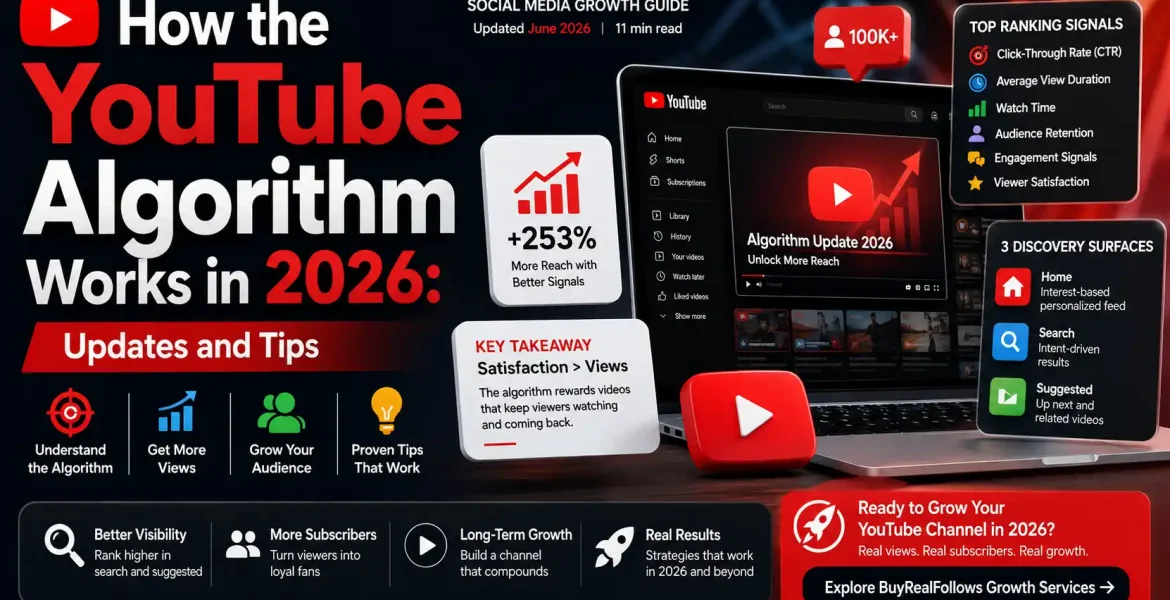
SOCIAL MEDIA GROWTH GUIDE | Updated June 2026 | 11 min read
WHAT YOU’LL LEARN IN THIS GUIDE
- How the YouTube algorithm works in 2026 across Home, Search, and Suggested
- The exact signals YouTube uses to rank videos
- What changed this year and why
- How watch time, CTR, and satisfaction interact
- Where subscribers still matter and where they do not
- Practical tips to earn more reach
- The mistakes that quietly limit your channel
The YouTube algorithm in 2026 is not one system but a set of recommendation engines that each answer a different question: what should we show on the Home feed, what best matches a search, and what should play next. Understanding how the YouTube algorithm works in 2026 is the difference between guessing at thumbnails and building a channel that compounds. Get the signals wrong and even good videos stall at a few hundred views.
This guide breaks down each surface, the ranking signals behind it, and the changes that matter this year. It is written for creators and brands who want real growth, and it covers where paid support like YouTube view services from BuyRealFollows fits into a launch without replacing the fundamentals. If you also run Instagram, the patterns rhyme with the Instagram Algorithm Guide 2026.
**QUICK ANSWER: HOW THE YOUTUBE ALGORITHM WORKS IN 2026** The YouTube algorithm in 2026 ranks videos by predicted satisfaction, not raw views. It pairs click-through rate with average view duration, then watches whether viewers stay, return, and engage. Home and Suggested are interest-based and drive most reach, while Search rewards relevance and retention. Subscribers shape your baseline distribution but no longer guarantee that your videos are shown.
1. The Three Surfaces That Decide Your Reach
YouTube does not have a single feed. It has three main discovery surfaces, and each ranks content differently.
Home. The default screen when someone opens YouTube. It is interest-based and personalized, mixing videos from channels a viewer watches with new channels the system predicts they will enjoy. Most channel growth in 2026 comes from Home.
Search. Query-driven and closest to Google. It rewards titles and content that match intent, backed by strong retention on that topic. This is where evergreen videos earn views for years.
Suggested. The sidebar and autoplay engine. It pushes videos related to what someone just watched. Strong Suggested performance is how a single video can snowball.
KEY INSIGHT
Most reach on a growing channel comes from Home and Suggested, where non-subscribers discover you. Your subscriber count sets a floor for distribution, not a ceiling.
2. The Core Ranking Signals in 2026
YouTube’s recommendation system tries to predict satisfaction. These are the signals it leans on, roughly in order of weight:
- Click-through rate (CTR) on impressions. Does your thumbnail and title earn the click?
- Average view duration and percentage viewed. Do people stay once they click?
- Watch time in total. Long retention on longer videos compounds.
- Returning viewers and session time. Does your video keep people on YouTube?
- Engagement quality, including likes, comments, and shares relative to views.
- Satisfaction surveys and dismissals. Explicit signals that tune recommendations.
CTR and average view duration work together. A high CTR with weak retention tells YouTube the title oversold the video, and reach drops fast.
3. What Changed in 2026
Three shifts define how the YouTube algorithm works in 2026:
- Satisfaction over raw watch time. YouTube weighs whether viewers feel the time was well spent, using surveys and return behavior, not just minutes watched.
- Shorts feed long-form discovery. Shorts now act as a top-of-funnel that routes viewers toward a channel’s long videos and subscriptions.
- Faster early evaluation. The system reads the first hour or two of a video’s performance and decides whether to widen impressions, so a weak start is harder to recover from.
KEY INSIGHT
A high click-through rate paired with low average view duration is the fastest way to lose reach. YouTube reads it as a misleading thumbnail and stops serving impressions.
4. Where Subscribers and Social Proof Fit
Here is the honest version. Subscribers in 2026 are a trust and baseline-distribution signal, not a guarantee of views. A new channel with zero subscribers faces a cold-start problem: the algorithm has little behavioral data and few impressions to learn from.
Social proof helps break that cold start. A video that already shows views and engagement earns more clicks from real viewers than one sitting at zero, which gives the algorithm the early data it needs. Used correctly, real YouTube subscribers from BuyRealFollows and an initial layer of YouTube views establish baseline credibility while your content does the real work.
SAFETY NOTE
If you use a growth service, choose real subscribers and views from active accounts with a refill guarantee, like BuyRealFollows. Bot views inflate the counter but never watch, which drags down average view duration, the exact signal YouTube ranks on.
5. How YouTube’s Policies Treat Engagement
Be accurate here. YouTube’s Terms of Service and Community Guidelines prohibit artificial engagement from bots and fake traffic. Views and subscribers from real, active accounts are treated differently from bot networks, which YouTube’s systems detect and purge. As of 2026, the practical risk comes from low-quality bot providers, not from real engagement delivered at a natural pace. Always pair any paid support with genuine content.
6. Practical Tips to Work With the Algorithm
- Earn the click honestly. Test thumbnails and titles, but never oversell. CTR with retention beats CTR alone.
- Win the first 30 seconds. Open with a clear payoff so average view duration holds.
- Design for session time. End screens and playlists that keep viewers on YouTube boost your standing.
- Publish on a consistent cadence the algorithm can learn from.
- Use Shorts as a funnel to your long-form, not as a separate strategy.
- Establish social proof early with real views and subscribers if you are starting cold, then let content carry it.
7. Common YouTube Algorithm Mistakes in 2026
| Mistake |
Why It Hurts |
Fix |
| Clickbait thumbnails |
High CTR, low retention, reach collapses |
Match thumbnail to payoff |
| Slow intros |
Average view duration drops in the first 30 seconds |
Lead with the payoff |
| Buying bot views |
Tanks average view duration, a core ranking signal |
Use real views and subscribers only |
| Ignoring CTR |
Great videos never earn the click |
Test titles and thumbnails |
| Treating Shorts as separate |
Misses the funnel into long-form |
Route Shorts viewers to long videos |
| Inconsistent uploads |
The system cannot learn your channel |
Hold a steady cadence |
8. Key Takeaways
- The YouTube algorithm in 2026 is three surfaces: Home, Search, and Suggested.
- It ranks by predicted satisfaction, pairing CTR with average view duration.
- Home and Suggested drive most discovery from non-subscribers.
- Subscribers set a baseline but no longer guarantee views.
- Shorts now feed long-form discovery and subscriptions.
- The first hour of performance heavily shapes how far a video spreads.
- Social proof solves the cold-start problem but never replaces content.
- Real views and subscribers protect average view duration; bots destroy it.
- YouTube targets bot traffic, not real engagement, as of 2026.
- Earn the click honestly, win the first 30 seconds, and stay consistent.
Frequently Asked Questions
How does the YouTube algorithm work in 2026?
It works as three recommendation surfaces, Home, Search, and Suggested, that each rank videos by predicted viewer satisfaction. The system pairs click-through rate with average view duration, then watches whether viewers stay, return, and engage. Home and Suggested drive most of the reach for a growing channel.
Do subscribers still matter for YouTube reach?
Subscribers matter as a baseline and trust signal, but they no longer guarantee that your videos are shown. The algorithm decides each video’s distribution based on performance signals. A strong subscriber base helps your first hour of data, which is why real YouTube subscribers can support a launch.
What is the most important YouTube ranking signal?
Average view duration paired with click-through rate is the most important combination. A high CTR earns the impression, and strong retention tells YouTube the video delivered. One without the other limits reach.
Does buying YouTube views help with the algorithm?
It can help with the cold-start problem by giving a new video visible traction, which earns more clicks from real viewers. It only helps if the views come from real accounts that actually watch. Bot views lower average view duration and work against you, so quality is everything.
How long does it take to grow on YouTube in 2026?
Most channels need consistent uploads over several months for the algorithm to learn their audience and for evergreen search videos to mature. Social proof can shorten the cold start, but sustainable growth comes from retention and consistency rather than any single trick.
Ready to Grow Your YouTube Channel in 2026?
Strong content earns the algorithm’s trust, but visible social proof helps real viewers click in the first place. BuyRealFollows delivers real YouTube views, subscribers, and likes with refill guarantees so you can break the cold start while your content compounds.
Explore BuyRealFollows Growth Services →
Embracing the principles of how the YouTube algorithm works will enhance your content’s potential.
In 2026, knowing how the YouTube algorithm works can set you apart from others in your niche.
As the YouTube algorithm works to prioritize viewer satisfaction, creators must adapt.
Understanding how the YouTube algorithm works is key to designing effective content strategies.
To thrive on YouTube, understanding how the YouTube algorithm works is no longer optional.
The changes in how the YouTube algorithm works can impact video visibility significantly.
Content creators must adapt to how the YouTube algorithm works to stay relevant and visible.
Success on YouTube is directly related to how well you understand how the YouTube algorithm works.
When you understand how the YouTube algorithm works, you can tailor your strategy to meet its requirements.
Learning how the YouTube algorithm works will help you create better content that resonates with viewers.
To maximize reach, you need to understand how the YouTube algorithm works and how it evaluates content.
Mastering how the YouTube algorithm works can lead to substantial improvements in video performance.
Understanding how the YouTube algorithm works is essential for creators aiming for success in 2026.
Written by
Mark A . Johnson
Mark A. Johnson is a social media growth strategist and content lead at BuyRealFollows.com. With over a decade of experience in platform research and digital marketing, he helps brands and creators build real audiences on Instagram, YouTube, TikTok, Facebook, and Spotify. His work focuses on algorithm analysis, engagement mechanics, and social proof strategy. Mark writes practical, research-backed guides to help readers grow their presence with confidence.
Instagram Growth
YouTube Monetization
TikTok Strategy
SEO Content
Creator Economy
View all posts