Funny thing about Spotify: the app feels like magic until you’re the one trying to get noticed on it. One day you’re listening to a random playlist and stumble on an artist you’ve never heard of, and you think, “Wow, how’d this even find me?” The next day, you’re uploading your own track—or maybe promoting your brand—and realize the opposite question is haunting: why isn’t anyone finding me?
That, in a nutshell, is the Spotify algorithm. It’s not luck. It’s not some DJ in the clouds handpicking songs. It’s a system, a giant, humming machine making invisible choices every second. Understanding that system is half the battle.
Table of Contents
Why Spotify Algorithm Matters?
Look, Spotify isn’t small potatoes anymore. Over 600 million people are streaming there every month, and—get this—100,000 songs go live every single day. Wrap your head around that. You’re not shouting into a crowd; you’re whispering into a stadium during a rock concert.
So, yeah, the algorithm matters. If you can figure out how to nudge it in your favor, suddenly you’re not invisible. Suddenly, the right people are hearing your stuff—or your message—without you buying ads or begging.
What Is the Algorithm Really?
It’s not just one switch. It’s three overlapping systems working in the background, kind of like three friends who all have different ways of recommending a restaurant.
The Collaborative Guy: “People who liked this band also liked yours.” That’s collaborative filtering. It looks at listening habits and overlaps.
The Word Nerd: This one reads. Blogs, reviews, tweets. If your song’s being talked about alongside “lofi beats” or “study jams,” Spotify tags it as such.
The Audio Geek: This one listens closely. Tempo, mood, energy—every little piece of sonic DNA. It’s why your mellow track gets grouped with other night-drive songs.
Photo by Bryan Catota
Together, they power your shot at landing on those shiny playlists: Discover Weekly, Release Radar, Daily Mix. If you’re trying to grow, that’s the sweet spot.
What They’re Watching
The system doesn’t just care that you uploaded. It’s watching what people do with your track:
Skips: Bail in the first 30 seconds? Bad news.
Finishes: If listeners stay till the end, that’s good.
Saves/Playlists: The gold medal. When someone adds your track to their personal playlist, that’s a long-term endorsement.
Follower Growth: A steady climb beats one viral spike.
So, yeah, you can have a thousand streams, but if 800 people skipped? That hurts. Sometimes 100 loyal plays are worth more than 10,000 careless clicks.
Discovery Is Staged
Here’s how it really rolls out: Spotify doesn’t just blast your song to the world. First, it tries you out on a tiny group—people whose history lines up with your vibe. If they respond? The circle widens.
It’s basically the digital version of “Tell a friend.”
Here’s a rough map:
Stage
Who Hears You
What Matters
What Happens Next
First Test
A tiny, specific audience
Skips
Determines if you get a shot at more
Expansion
A bigger, still-niche crowd
Saves + repeats
If strong, playlists open up
Scale
Major playlists + mixes
Consistency
Long-term exposure
So those early listeners? They’re your launch pad—or your brick wall.
The Self-Sabotage Trap
A lot of creators trip over this. They chase numbers like they’re candy. But here’s the kicker: bad numbers hurt.
If you jam a song in front of the wrong audience just to see streams rise, all those skips tell Spotify, “No thanks.” And that signal lingers.
Quality over quantity isn’t just a slogan here—it’s math.
The Playlist Kingdom
Playlists are where dreams are made. Three kinds matter:
Editorial: Handpicked by Spotify staff (think RapCaviar). Landing here is jackpot.
Algorithmic: Auto-built by data (Discover Weekly). Earned by signals, not schmoozing.
User-Curated: Everyday people making mood mixes. Easier to crack, often overlooked, but surprisingly powerful.
Photo by cottonbro studio
If you’re smart, you treat user lists like stepping stones to algorithmic ones. That’s where momentum often begins.
Why Social Media and Spotify Are Tied Together
Here’s the bigger twist: Spotify isn’t just music—it’s culture currency. A 15-second hook from your track can jump to TikTok or Instagram Reels overnight. Suddenly, streams spike because a meme picked you up.
That’s why even non-musicians should care. Businesses, influencers, side hustlers—it’s all connected. The Spotify system runs on the same principles as TikTok’s “For You” or YouTube’s “Recommended.”
Tools designed to boost Spotify growth can also make a difference— not in the “fake it till you make it” sense, but in the early-traction-matters way. Algorithms respect momentum. When your content already looks alive, it’s easier for the system to keep it alive.
Three Moves That Actually Work
If you’re lost in theory, here’s where you act:
1. Metadata Matters
Call your track something meaningful. Titles and tags feed the system. A song called “Untitled Track 3” tells Spotify nothing. A song called “Summer Haze – Indie Pop Remix” points the algorithm somewhere useful.
2. Hook Them Fast
Photo by Freepik
The first 30 seconds are life or death. Listeners decide quick. Front-load your best stuff and make them stay.
3. Cross-Platform Push
Spotify notices when traffic comes in from Instagram, TikTok, or YouTube. Those clicks and embeds? They echo back as social proof.
What the Algorithm Really Rewards
It’s not hacks. It’s rhythm.
Consistent uploads tell Spotify you’re active.
Consistent engagement tells it you’re valued.
Cross-platform presence tells it you’re relevant.
It’s closer to exercise than a lottery. Small, steady moves beat occasional bursts.
Bigger Than Spotify
Here’s the real secret: Spotify isn’t special. It’s just visible. The same pattern—collaborative filtering, text analysis, behavior signals—powers nearly every modern platform. Instagram, TikTok, YouTube… they’re all variations on the same theme.
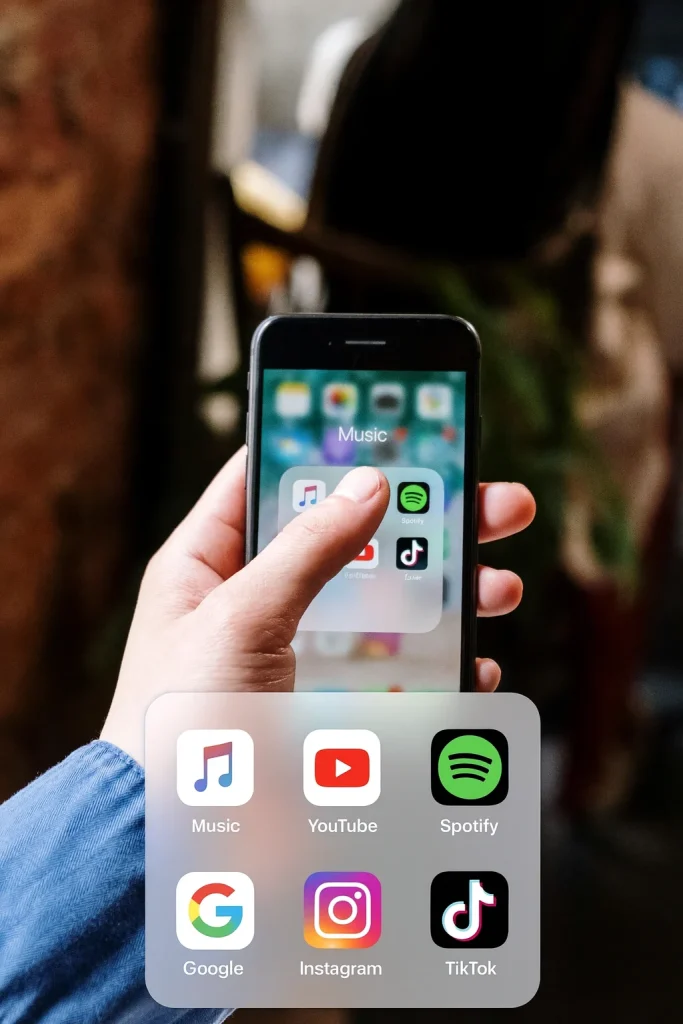
Spotify multiple social media icons
So learning this system isn’t just about boosting your next track. It’s about seeing how attention itself works in 2025.
The question isn’t, “How do I game the system?” It’s, “How do I align with what the system already wants?”
Get that right, and you’re not fighting the tide—you’re surfing it.
Final Thought
Algorithms don’t just recommend music. They shape culture. They decide who rises, who fades.
Understanding Spotify isn’t a golden ticket. But it tilts the odds. And in a world where attention is scarce, tilting the odds might be all you need.
Verified Author
Written by
Mark A . Johnson
Mark A. Johnson is a social media growth strategist and content lead at BuyRealFollows.com. With over a decade of experience in platform research and digital marketing, he helps brands and creators build real audiences on Instagram, YouTube, TikTok, Facebook, and Spotify. His work focuses on algorithm analysis, engagement mechanics, and social proof strategy. Mark writes practical, research-backed guides to help readers grow their presence with confidence.
WHAT YOU'LL LEARN IN THIS GUIDEWhat separates a safe TikTok follower provider from one that risks your accountThe five criteria every reliable TikTok follower site must meet in 2026How BuyRealFollows,…
WHAT YOU'LL LEARN IN THIS GUIDEWhy your Facebook page has no engagement and what the algorithm actually prioritizes in 2026The four specific signals Facebook uses to decide which posts to…
WHAT YOU'LL LEARN IN THIS GUIDEWhy most bought TikTok views drop or disappear within days and what causes itThe specific signals TikTok uses to validate views as real versus artificialWhat…
WHAT YOU'LL LEARN IN THIS GUIDEThe real differences between Twicsy and BuyRealFollows across follower quality, pricing, and platform coverageHow Twicsy's three-tier follower system (High-quality, Active, VIP) compares to BuyRealFollows' approachWhich…
WHAT YOU'LL LEARN IN THIS GUIDEWhat SocialWick is and how it differs from BuyRealFollows in platform scope and pricingSocialWick's 15+ platform catalog versus BuyRealFollows' focused 5-platform modelA verified pricing comparison…