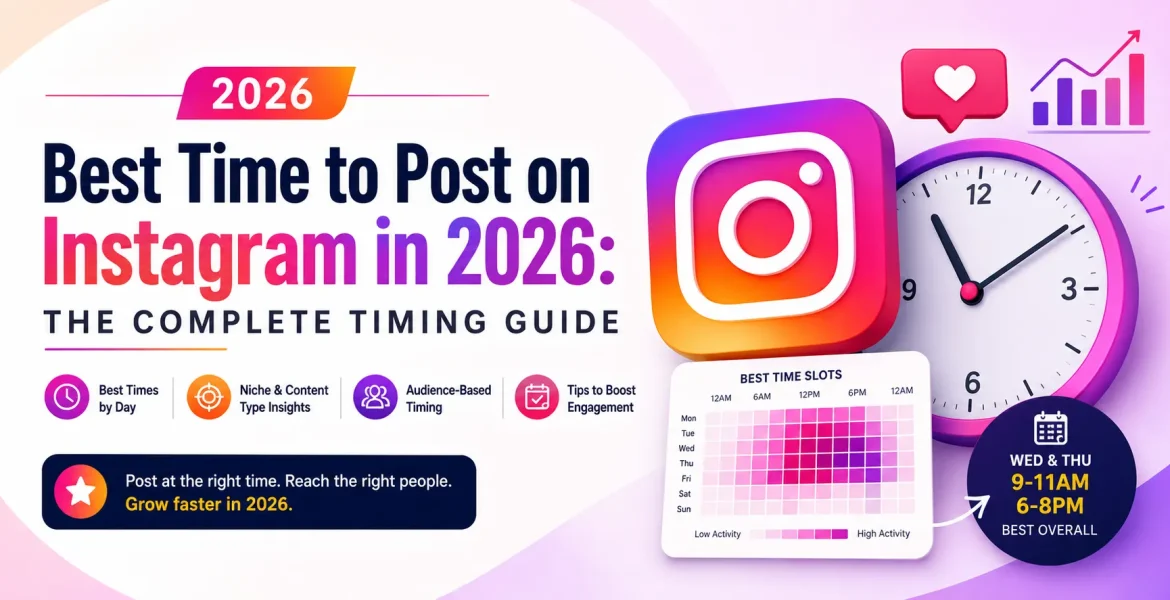
The best times to post on Instagram in 2026 are Tuesday through Friday between 9–11am and 6–8pm in your audience’s local timezone. Wednesday at 10am and Thursday at 7pm consistently perform well across most niches. However, the most accurate best time for your account is found in Instagram Insights under Audience → Most Active Times—this data is specific to your followers and more reliable than any generic benchmark.
Posting at the right time on Instagram can be the difference between a post that reaches 500 people and one that reaches 5,000—even if the content is identical. The timing affects your early engagement velocity, which is one of the signals Instagram’s algorithm uses to decide how broadly to distribute your content.
This guide covers the best times to post on Instagram in 2026, broken down by day, niche, and content format—plus how to find the ideal posting time specific to your audience.
What You’ll Learn
The best days and times to post on Instagram in 2026
How posting time affects Instagram’s algorithm distribution
Best posting times broken down by niche and content type
How to find the ideal posting time for your specific audience
Why consistency matters more than any single “perfect” time slot
Tools and methods for scheduling posts at optimal times
Why Posting Time Matters for Instagram Reach
Instagram’s algorithm evaluates early engagement signals—how quickly a post accumulates likes, comments, saves, and shares—to determine how broadly to distribute it. Posts that generate strong engagement in the first 30–60 minutes are pushed to more followers’ feeds and have a better chance of landing on the Explore page.
Posting when your audience is active means more people see your content immediately, which generates those early signals faster. A post published at 3am when your followers are asleep starts with a disadvantage it may never fully recover from—even if the content is excellent.
Key Insight
Recency is one of Instagram’s five core ranking signals. Even a well-performing post from 48 hours ago gets deprioritized in the feed compared to a newer post with similar engagement signals. This is why consistent posting at optimal times compounds over time—each post gets a fresh algorithmic evaluation at the moment of highest audience activity.
Best Times to Post on Instagram by Day (2026)
Day
Best Time Slots
Performance Level
Monday
8–10am, 6–8pm
Good
Tuesday
9–11am, 7–9pm
Excellent
Wednesday
9–11am, 6–8pm
Best overall
Thursday
9am, 7pm
Excellent
Friday
9–11am, 12–1pm
Very good
Saturday
9–11am
Good (lower overall activity)
Sunday
10am–12pm
Moderate
Wednesday and Thursday consistently rank as the highest-engagement days across most niches. Weekend posts tend to underperform because users are more likely to be offline or engaged in offline activities, particularly on Sunday afternoons and evenings.
Best Posting Times by Niche
General benchmarks are useful starting points, but niche significantly affects when your audience is online. Here’s a breakdown of optimal posting windows by content category:
Niche
Best Posting Times
Why
Food & Recipes
Weekdays 11am–1pm, 5–7pm
People browse during lunch and before dinner
Fitness & Health
Mon–Fri 6–8am, 6–8pm
Before and after workout windows
Business & Marketing
Tue–Thu 9–11am
Peak professional browsing hours
Fashion & Beauty
Weekdays 8–11am, 8–10pm
Morning commute and evening wind-down
Travel
Fri 11am–1pm, Sun 10am
Weekend planning and inspiration
Entertainment
Weekdays 7–10pm
Evening leisure browsing
E-commerce / Products
Mon–Fri 12pm, 7–9pm
Lunch browsing and post-work shopping
Best Times to Post Reels vs Feed Posts vs Stories
Content format affects optimal timing because Reels, feed posts, and Stories behave differently in the algorithm. Reels are distributed to non-followers and can go viral at any hour—but posting Reels during peak activity hours still gives them a stronger initial push. Feed posts are most time-sensitive because they compete directly with other recent content in followers’ feeds. Stories are consumed throughout the day but tend to peak during morning commutes (7–9am) and evening hours (7–10pm).
Key Insight
Reels have the longest shelf life of any Instagram content format. A Reel posted on Wednesday morning can continue accumulating views and followers days later if the algorithm continues distributing it. This makes Reels more forgiving of non-peak posting times compared to static feed posts, which compete directly in a time-ranked feed.
How to Find the Best Posting Time for Your Specific Audience
Generic benchmarks are useful, but your audience may have different habits. Instagram Insights gives you audience-specific data that’s far more accurate than any general guide. Here’s how to access it: open Instagram, go to your professional profile, tap Insights, then select Audience. Scroll down to “Most Active Times” to see a breakdown by hour and by day of when your specific followers are most active on the platform.
Use this data to identify your top 2–3 posting windows per week. Cross-reference with your best-performing posts (check their posting times in Insights) to validate which times actually drive strong early engagement for your content.
Important Note
Instagram Insights “Most Active Times” shows when your followers are online—not when they’re most likely to engage with your specific content type. Test your top 3 time windows over 4–6 weeks and compare engagement rates per post to find what actually drives results for your account.
Consistency Matters More Than Any Single Perfect Time
Optimizing your posting time is valuable, but consistency is more important than hitting the exact optimal minute. An account that posts at 9:15am every Tuesday and Thursday will consistently outperform one that posts at peak times sporadically. Instagram’s algorithm rewards predictable posting patterns—regular posting signals that your account is active, which improves how the algorithm categorizes and distributes your content over time.
Use Instagram’s built-in scheduling tool (available through Meta Business Suite) or third-party schedulers like Later or Buffer to queue posts at optimal times without needing to be online manually. Scheduling at the right time while you’re away is significantly better than posting at a random time just to stay “consistent.”
Time Zone Considerations for Global Audiences
If your audience spans multiple time zones, Instagram Insights shows follower activity in your own timezone. If a significant portion of your followers are in a different timezone—say you’re in London but 60% of your followers are in New York—you need to adjust your posting schedule accordingly. Posting at 9am London time (4am New York time) means your largest audience segment is asleep.
For accounts with highly distributed global audiences, consider posting twice daily—once for each major timezone segment—to maximize reach across your full follower base.
Key Takeaways
Wednesday and Thursday 9–11am and 6–8pm are the strongest general posting windows for most niches
Early engagement velocity (first 30–60 minutes) is what determines how broadly Instagram distributes your post
Use Instagram Insights → Audience → Most Active Times to find times specific to your followers
Reels are more forgiving of off-peak posting than feed posts; Stories peak in morning and evening
Posting niche affects optimal timing—fitness audiences peak early morning; entertainment audiences peak evenings
Consistency matters more than perfection—a reliable schedule beats sporadic peak-time posting
Adjust for your primary audience’s timezone if it differs significantly from your own
Frequently Asked Questions
What is the single best time to post on Instagram?
Wednesday between 9–11am is the most consistently cited peak time across multiple studies and niches. However, the actual best time for your account depends on your specific audience’s habits, which you can find in Instagram Insights. Treat general benchmarks as a starting point, then test and refine based on your own data.
Does posting time affect Instagram Reels performance?
Yes, but less than it affects feed posts. Reels are distributed to non-followers through the Reels tab and Explore page, which means they can accumulate views long after posting. That said, posting Reels during peak hours still generates stronger early engagement signals, which can trigger broader algorithmic distribution faster.
How often should I post on Instagram in 2026?
Posting 4–7 times per week (combining feed posts, Reels, and Stories) is the sweet spot for most accounts. Quality and consistency matter more than raw frequency. It’s better to post 4 high-quality pieces per week at optimal times than 10 mediocre posts at random hours.
Is there a worst time to post on Instagram?
Late night posts (11pm–5am) and Sunday afternoon posts (2–5pm) consistently underperform. These windows see the lowest active user counts across most demographics. If you’re scheduling content in advance, avoid these windows unless your Insights data specifically shows your audience is active then.
Should I post at the same time every day?
Posting at the same time daily isn’t necessary, but posting within consistent time windows is beneficial. Pick 2–3 time slots per week that fall within your audience’s peak activity hours and stick to those. This trains your followers to expect new content and helps the algorithm recognize your posting pattern.
Post at the Right Time to the Right Audience
Timing is one piece of the puzzle. Building a quality follower base ensures your optimally-timed posts reach people who actually engage.
Mark A. Johnson is a social media growth strategist and content lead at BuyRealFollows.com. With over a decade of experience in platform research and digital marketing, he helps brands and creators build real audiences on Instagram, YouTube, TikTok, Facebook, and Spotify. His work focuses on algorithm analysis, engagement mechanics, and social proof strategy. Mark writes practical, research-backed guides to help readers grow their presence with confidence.
WHAT YOU'LL LEARN IN THIS GUIDEWhat separates a safe TikTok follower provider from one that risks your accountThe five criteria every reliable TikTok follower site must meet in 2026How BuyRealFollows,…
WHAT YOU'LL LEARN IN THIS GUIDEWhy your Facebook page has no engagement and what the algorithm actually prioritizes in 2026The four specific signals Facebook uses to decide which posts to…
WHAT YOU'LL LEARN IN THIS GUIDEWhy most bought TikTok views drop or disappear within days and what causes itThe specific signals TikTok uses to validate views as real versus artificialWhat…
WHAT YOU'LL LEARN IN THIS GUIDEThe real differences between Twicsy and BuyRealFollows across follower quality, pricing, and platform coverageHow Twicsy's three-tier follower system (High-quality, Active, VIP) compares to BuyRealFollows' approachWhich…
WHAT YOU'LL LEARN IN THIS GUIDEWhat SocialWick is and how it differs from BuyRealFollows in platform scope and pricingSocialWick's 15+ platform catalog versus BuyRealFollows' focused 5-platform modelA verified pricing comparison…